
Secrets Held in Leaves Falling
On how to find your voice

“Too many jazz pianists limit themselves to a personal style, a trademark, so to speak. They confine themselves to one type of playing. I believe in using the entire piano as a single instrument capable of expressing every possible musical idea. I have no one style. I play as I feel.”
Oscar Peterson
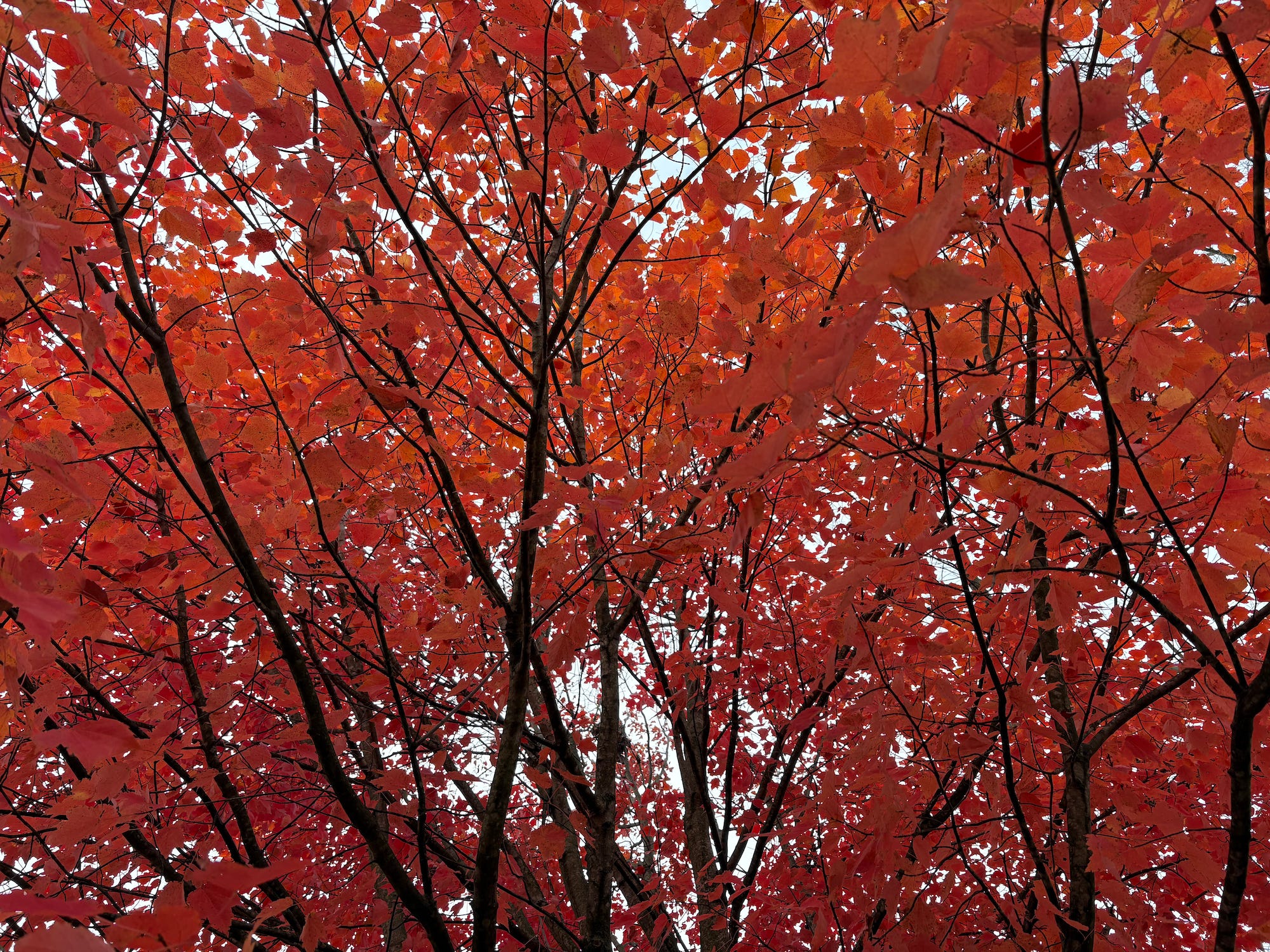
It was Tuesday morning. I was sitting in the basement, mostly in the dark, lit only by the three lamps that I’d placed on my desk, which, when viewed together, somewhat resembled Cerberus, the three-headed dog.
I had been thinking about confidence, or, more specifically, about how some people seem to be brimming with it. Why am I not brimming with it? Why am I constantly second-guessing myself? It’s not as if I don’t understand the mechanisms at play—the fear, the insecurity, the compensating and overcompensating, the interplay of nature versus nurture that have molded me into the person I am today. Yet I still felt as if there had to be a better way.
When I was studying music at Berklee, I had been playing my guitar so much that I had become sick of it. Despite how many hours I played, I was still nowhere near as good as many of the other students. Jazz was a foreign language that everyone else seemed to know except for me.
I went into one of the practice rooms one listless afternoon and started playing the piano—the first instrument I learned and the one I had abandoned for the guitar. I was learning Claire de Lune by Debussy, or rather, re-learning it after years of neglect. About thirty minutes into my practice session, a girl knocked on my door and said, “I just have to tell you—the piano you’re playing sounds beautiful. I’ve been listening to it from the other practice room and loving it.”
She smiled and walked away before I could even get the chance to properly thank her. I closed the door of the practice room and returned to the piano bench, staring at the silent keys before me. I was dumbfounded. In the years that I had been at Berklee, not one of my peers had complimented me on my guitar playing. And here, on a whim in the first thirty minutes of playing the piano—classical, no less—someone praised me.
It confirmed what I had feared: that playing the guitar was likely not my calling. I had already been studying music business, and was clearly more business-minded than most of my peers, but the realization of this fact still stung. I had poured so many hours into the instrument, and just like that, my confidence was drained away like water through cupped hands.
As a writer, confidence is everything, because it’s only with conviction that a writer finds their voice. It takes a special combination of courage and passion to say things that others don’t say and to say them in a way that is compelling enough to be worth your time to read.
Here’s the real question: How can anyone be so sure of themselves?
How can I, knowing the uncertain and unpredictable nature of life, look at myself in the mirror and feel that everything will be alright, despite what the external world is telling me, because I have enough blind faith in myself that I know I will figure it out?
Is it something that can be learned? Or is it something that you either have or you don’t?
I let out a deep sigh and rubbed my tired eyes, hoping an answer might drop out of the white popcorn ceiling and into my lap. Perhaps it will come tomorrow.
On Wednesday, I left the basement.
In the shimmer of broad daylight, you get to see the world as it really is. For me, it was autumn. Splotches of green and yellow and red clung to the trees. There seemed to be an everflowing stream of leaves falling, always falling, next to my window. It was impossible for the leaves to keep falling, and yet they did.
Just yesterday, in the late afternoon, I had a long conversation with a friend who had been asking herself many of the same questions that I had been asking too.
“I feel as if I can’t write anymore,” she said. “I used to write all the time. I was so sure of it. And now I just can’t do it. I’ve lost myself. Where has my voice gone?”
I said to my friend: “What if you haven’t lost your voice or your confidence or your personality? What if you’re just down on your luck, and it’s really that simple, and soon enough you’ll get it all back?”
That’s of course not an answer. But it was a good question. I wasn’t sure if I was asking her, or myself. I took a sip of my coffee. It had run cool—dirty brown water sitting at the base of an off-white mug.
I thought again of the trees, with their exposed branches jutting out like twisted bare arms. I wondered if they get embarrassed, being so naked. They have no choice in the matter, and yet they follow the whims of the seasons so diligently. A tree is a tree when it has its leaves, and a tree is a tree when it doesn’t. We’re really no different. Up when we’re up and down when we’re down. However, I assume the tree doesn’t worry about its identity.
What does the tree say, then, with the voice it does not have?
The tree tells me to be steadfast and patient, to allow for change, to transform often. To stretch and to climb. The usual platitudes. But there is nothing frantic or hurried about the way the tree speaks; it is slow and it is certain. I look closely now at the exposed branches, and I see the scars that have been left behind. I wonder how they got there. The tree doesn’t tell me.
By Thursday, I thought I figured it out.
I read an essay about how voice is what happens when you no longer cling to self-consciousness, and you instead focus solely on getting words on the page. A first draft. There’s an openness to it, isn’t there?
And wasn’t self-consciousness exactly my problem? At Berklee, I’d been so conscious of how I compared to others that I’d forgotten to just play. The girl who complimented my piano playing hadn’t heard me trying to be a jazz musician—she’d heard me, unconsciously, being myself.
The essay argued that voice is writing about what you know, the things that are inherently part of you, the small details of your life that only you can collect and tend to and share.
This reminded me of a detail from my own life—this road in town, a road that I don’t drive often, but a road that has a sharp bend to the right, where, at the bend, a small pizza shop sits, one that I haven’t been to in over a decade. I used to go to this pizza shop when it was known by a different name—Serendipity Cafe—but now it has become an unfamiliar thing. I don’t remember how old I was, likely only a teenager, when I found the Serendipity Cafe. The food was nothing memorable, but the name. The name was perfect. Because if finding a pizza cafe, hidden behind the bend of a road that’s not often traveled is not serendipity, then what is?
I hadn’t been looking for the cafe that day. I’d just been driving. And maybe that’s how confidence works too—not by searching desperately for it, but by moving forward until you turn a corner and realize it was always there, waiting behind your self-consciousness.
I am looking for something; I am looking for my voice. There is this thing I crave, this little serendipity—a pocket of brilliance radiating from the unknown, reaching out and extending a helpful hand to me. But where is it? I do not know.
Voice emerges in the act of creation itself. It’s having the confidence to take the turn without knowing what’s around the bend, and, once you’ve turned the corner, to enjoy the serendipity of finding something that was always there.
That’s what we want, isn’t it? Certainty?
A certain voice. A certain identity. A certain way of being.
Nothing is certain. Except for the slow, measured cadence of the way the tree spoke to me.
I am in bed. It is Friday night. It is late. I should be asleep. I am watching a television interview from 1979—Oscar Peterson on the Dick Cavett show. I am smiling. Oscar is sweating, constantly dabbing himself with a white handkerchief kept on top of the piano, but he is also at ease, laughing at every joke Dick makes. Watching him is watching something alien and incredible, like a genie uncorked from a bottle to answer each of Dick’s requests. Magic sits at his fingertips.
Dick asks him to play the stylistic trademarks of other pianists. The stride piano of Art Tatum. The two-fingered percussiveness of Nat Cole. The lyric octave work of Erroll Garner. The relaxed block chords of George Shearing. Double octave melody lines. Linear inventions. Tonality based tunes.
He seems to know everything there is to know about playing jazz piano. Nothing stumps him. Nothing even trips him up. The wisdom of every great pianist lives inside of him. He is the totality of jazz, the culmination of music, the opposite of how I felt at Berklee.
I wonder: how can he carry so much and still have his own voice? If he is everyone, then who is he that others aren’t?
I want to ask him, but he has been gone for nearly twenty years. So I listen to his music.
By Saturday, the autumn leaves are everywhere. They dance and swirl on sprawling green lawns and side streets, and they bunch up in the gutters, choking the drains like a fistful of orange. The leaf blowers and rakes are ready for combat but don’t stand a chance. Not yet at least. Winter is far off. The crisp smoky sweetness that lingers in the air after the sun sets tells me that fall is eager to stay.
Autumn leaves.
Autumn Leaves is an old jazz standard, one that Oscar Peterson played many times. In 1960, he played it like this: light and feathery, like the leaves themselves, blowing through the air before settling into the rhythm and swing of a sunny October afternoon. The notes were buoyant and warm, and he stayed with the melody—familiar and well-worn. It was proper; it was polished. His dexterity was restrained to show that he could but he didn’t.
In 1960, he played the way you ought to play. Like a man who was climbing the rungs of music and now sat at the top of a glittering career, with nothing but gold stretched out before him. He had not won any Grammys yet, but he had proven what his trio could do and how they could do it. He was a household name; on television, on radio, on the storied stages of North America and Europe.
But by 1974, fourteen years later, Autumn Leaves had transformed. It sounded like this: faster, more frantic, unbound by convention, and pressing forward. He shed the formality like the trees shed their leaves and let his technical mastery overpower and expand into wonder and abandon. The techniques come in waves—runs cascading into block chords, chords splintering into single-note lines that race and double back. Section bleeds into section, each one faster than the last, pushing against what seemed possible. If there was ever any doubt about what he could do, this erases it.
Which Autumn Leaves belong to Oscar—the ones from 1960 or the ones from 1974?
They both do. The keys he played told a story, one that shifted over time as the years of life filled his hands. His sound, his voice—these were the story itself, not separate from it. There was not one Oscar. There was a new one each time he touched the keys.
So is that what voice is—what we carry in the present moment?
Sunday morning. Sunlight pours through the windows like thick honey. Outside, the wind is once again shaking leaves off of trees; inside, it is near-silent, aside from the soft white hum of heat blowing through the vents.
I believe I have answers to my questions.
First, you go exploring. You drive on countless roads for hours and hours, making turns left and right and back again, until you stumble upon a cafe sitting at a sharp bend. You go inside. You order a slice of pizza and allow the fullness of your stomach to settle into gratitude. You’ve found something special. You’ve found something you want to return to.
Then, you fall in love. You start to understand that there is wisdom to be collected in this thing you’ve found, and that most wisdom is learned—pursued, chased with relentless fervor and passion. It is curiosity incarnate. It is the way Oscar Peterson absorbs Tatum and Cole and Garner and Shearing and gives them back transformed. It is love for a craft that never stops loving you back. It is the endless pursuit of mastery.
And finally, you let the things that are uniquely you take shape.
I think again of the scars on the tree outside my window, more pronounced now that it has become more bare. It does not hide them. I will never know how the tree got the ugly black wounds that climb up the length of its trunk. But I know that they are there and that they are not worth hiding.
This voice, this confidence, only exists in the present moment—a sum of everything you’ve carried here. It comes and goes. It stretches and bends, molded by the accidents of good luck and bad. When the time comes to use it, you only have what you bring, and you bring what you’ve had all along. There is nothing to find and nothing to lose.
With time, the tree has settled into itself, slower now, its roots dug deep into the soil of known experience. Quiet secrets are held in each leaf that falls to the ground.
It has many things left to tell me.
I lost my confidence about my voice, too. I became fed up with being gaslit (it's just negative self-talk, you just need more practice, etc). No. It's not negative self-talk because I read my favorite author and the prose has "something", and then I read my prose and it's dead. Whatever is in my favorite author's prose is certainly missing from mine. It's not a case of "good" or "bad"...something is missing.
This is when I had the horrible realization—is something missing from my writing? Or is the balance of ingredients all wrong? I have spent years looking for a missing ingredient, a certain something I can add to my writing that would automatically make it amazing. I would add this one secret ingredient and suddenly I would have a "voice". I'm beginning to think this is just fantasy though, because the chances are that it's more about balance.
The "missing ingredient" would be too easy. A much harder problem to solve is balance. What happens if I have all the right ingredients but the proportions are all wrong? This problem is infinitely harder to solve than a missing ingredient.
So am I doomed to just keep tweaking the ingredient ratios and hoping I stumble upon a recipe for a voice? This doesn't seem like a healthy way to approach this problem.
I'm still nowhere near finding my voice so I have no useful advice, but one thing I can say for sure is that reading bad prose is better for you than reading good prose. You mentioned how you felt like everyone at Berklee was better at playing the instrument than you were. This is the problem I have too...I read Nabokov and I desperately want my prose to be as good as his. Time to get real though, it is never going to be as good as Nabokov...but does it "really" need to be? Maybe I'm looking at the wrong target, though. I bet you can play the guitar (and piano) better than a good chunk of very famous musicians. They managed to use their limited playing skills and somehow created popular music, so If they can do it, so can you.
This is where I'm at now. I've spent (wasted) so much time wanting to be something I'm never going to be. This is a dead end and a sure way to never find my voice, but I'm getting more confidence from reading prose that isn't elite. I'm reading prose from famous authors and there is a little voice in my head saying "you can do that", or on the odd occasion, "you can do better than that".
I think that might be my big problem. I want to learn how to juggle 10 chainsaws before I know how to even juggle 3 balls. There are plenty of famous authors out there who can only juggle 3 balls, and they somehow managed to tell amazing stories that way. I don't need to juggle 10 chainsaws to tell my story, but I do need to be honest about my skill level and use it to my advantage.
Good luck finding your voice...I've been on this mission for the last 15 years, so God help the both of us.
Matt, this was amazing and I love how you structured this post. Personally, I feel I do my best writing not when I’m feeling the most confident about it but when I’m being truly vulnerable with the words I choose to put down. After all, there is something confident about having enough courage to be vulnerable in a world where so many mask their true emotions.